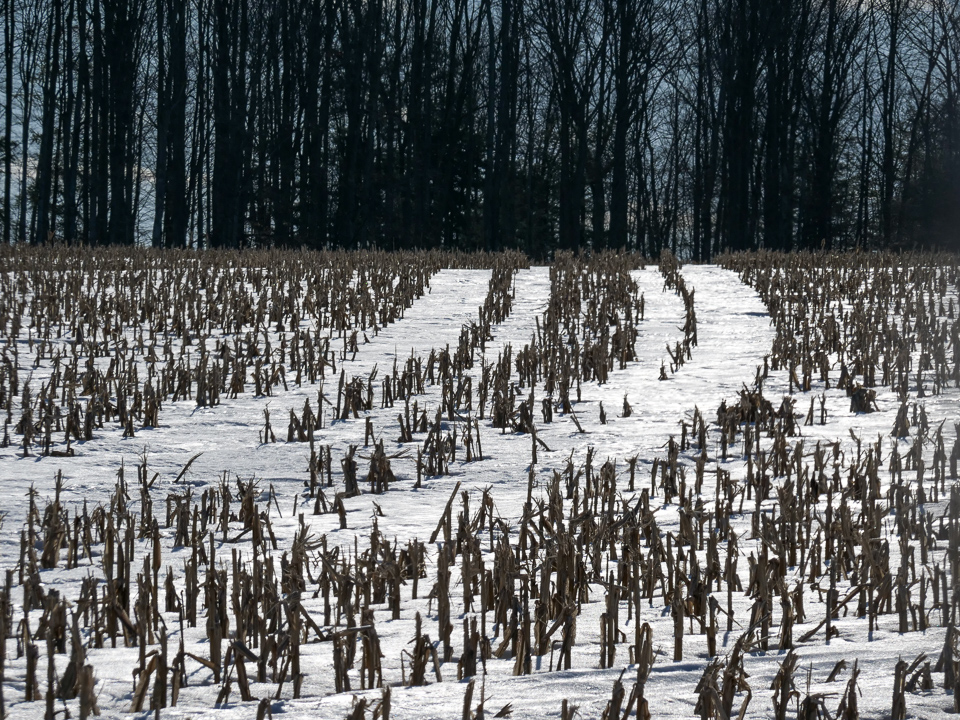
Thursday, March 26, 2020
COPING THROUGH FRESH AIR
The evening news was just about to come on, and I knew I couldn’t take another newscast devoted to the Coronavirus. Don’t get me wrong. I’m taking this pandemic very seriously through self-isolation, but everyone needs a break sometimes. A safe break, that is. Getting fresh air away from others is one way to do that. A walk. A bike ride. For me, a drive outside taking pictures is my way to cope. And with temperatures nearing 50 degrees, I can even put my window down. Woohoo!
So Gracie and I headed to the countryside. The roads were nearly empty. I was the only car heading south on M-37. As I turned off the highway onto my normal route, right away, I heard birdsong of the Red-winged Blackbird. This one was trilling away on a pussy willow branch.
A solitary Ring-billed Gull was walking with its silhouette along the edge of a farmland pond.
I also saw several groups of geese congregating near other water sources in the area. Surely, they’d been migrating together. And then I heard a familiar sound! One I’d been waiting to hear for over a month!
I wasn’t far from where I thought the sound was coming, so I took off around the block. There, in front of a thicket, I saw a pair of Sandhill Cranes grazing and preening near the roadside. I crept by slowly, not wanting to scare them off.
I’ve seen an abundance of cranes in this same block over the past few years. I’ve watched them pair bond and dance on several occasions. Last year, a crane family consisting of the parents and two juveniles occupied the block and were an object of both my affection and photography. I wondered whether these two cranes were the parents of the two juveniles born last spring. At around nine or ten months old, juveniles typically separate from their parents and join other non-breeding flocks to begin searching for their own mates.
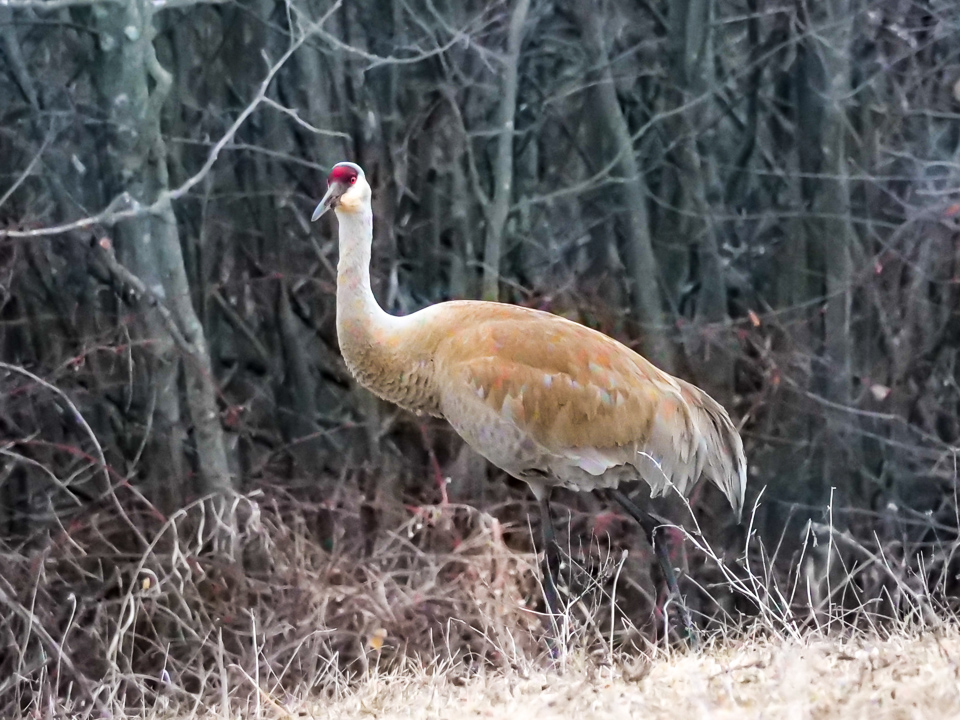
Along with Snowy Owls, Sandhill Cranes are my favorite subjects to photograph. They are such beautiful and interesting creatures, with their red and gray crowns and red eyes. They are very so statuesque, sometimes reaching four feet tall. Their wingspan can even reach seven feet.
Sandhill Cranes are very loyal critters. They mate for life, which sometimes lasts twenty years. Whenever I see cranes in the fields, one is pecking for food, while the other stands watch for threats, including eagles, owls, foxes, and wolves.
The cranes were ready to move on, and so were Gracie and I. I tell you, though, a drive or walk into the natural world can do wonders for one’s mental health. It was nice for me to focus my energy on something else, for a change.
Thursday, March 19, 2020
BIRDSONG IN THE AIR
I stepped out the door one morning this week and heard the welcome music of a favorite bird returning from its winter migratory spot.
A male Red-winged Blackbird was perched on the bare branches of a nearby bush. What a welcome harbinger of spring he was!
He must have been happy to be back because he was really belting out his rich, musical “o-ka-leeee” song. I've seen him on my feeders several times too.
Late that afternoon, I headed out to my favorite farm country. I hoped to see that spring-like changes had happened over the last week. I had my window cracked, and right away, I heard the songs of many Red-winged Blackbirds. This one was on a bush in a favorite swampy area where I see many of these birds perched on tops of cattails.
I also saw several returning Grackles perched atop some fir trees. They aren’t my favorite species because they tend to raid my feeders in large numbers and clean them out. But it’s spring now, or will be tonight at 11:50 p.m. EDT, so I’m happy to see all the birds.
As I drove on, I noticed many farmland ponds had opened up more. Parts of most had at least some flowing water, which would attract migrating birds who needed water for bathing or drinking.
I found a pair of Canadian Geese at the edge of one of these ponds. While many Canadian Geese stay in the area over the winter, they need an open water source, such as the south end of the Boardman Lake at Logan’s Landing. I’m guessing this pair was migrating because the farmland ponds had been frozen over all winter.
Another handsome pair was each standing on one leg on a patch of ice in the middle of the pond. I imagine they’d been napping or preening, and I’d interrupted them.
I drove on and was amazed at how much snow had melted in the fields in just one week. Another leap taken towards spring!
It was time to head home. I had a secret hope, though, and it was fulfilled as I turned onto the last part of my loop. I knew this was prime feeding time for deer, and I hadn’t seen any recently, but there on a distant hill, I saw five deer, bathed in the low light of the approaching sunset. Made my day.
Thursday, March 12, 2020
END OF THE DAY BONUS
I was out driving around with another photographer, showing her the farmland area where I often see critters, birds, and waterfowl. Because of the change to Daylight Savings Time, we were a bit early to catch feeding animals. We were headed for home, but, at the last minute, I decided to drive through the ballpark.
I’d been to the park recently and hadn’t seen any critters, but today our luck changed, and we saw a very large, female Snowy Owl sitting on the ground. Wow! A Snowy Owl sitting in a natural setting versus atop an ugly pole. That's a switch!
While the Snowy wasn’t moving much, except to swivel her head searching for prey, she was a challenge to photograph because so much else was moving! It was a windy day and the owl was sitting among many tall weeds which were continually moving in front of her. It was difficult to attain a focus just on the owl and not the weeds!
She turned my way, and it is always especially exciting to have the owl look directly at me with those bright yellow, piercing eyes.
The Snowy continued to swivel her head in all directions looking for something to eat, but she always knew exactly where I was.
It was a sunny day, and at times the Snowy squinted or employed her other eyelids to protect herself from the bright sunlight.
There were a couple times when the Snowy rose up and ruffled her wing feathers. I thought sure she was going to fly. They were false alarms, though.
Then another time, she dropped her head and took a short nap. The work of the Snowy must be tiring!
While I enjoy all the antics of Snowy Owls, it’s mostly the eyes that grab me. Their piercing yellow eyes are such a contrast to the delicate eyelashes and face feathers. She was sure an end of the day bonus!
Thursday, March 5, 2020
Gray Skies...Blue Skies...Gray Skies
Oh, the march to spring is SO slow and unpredictable. One day the weather is spring-like, teasing us with temperatures in the high forties and blue skies. For two or three days, we bask in the return of the sun. People are out walking in the neighborhood. Glorious weather. And then the gray skies return, along with a forecast of snow.
But there are still some harbingers of spring. I got an Audubon alert that someone had spotted two Great Blue Herons flying over near Hartman Road. I grabbed my camera, and Gracie and I headed out to one of the few places with open water, Logan's Landing. We drove around, but only saw swans and ducks.
I moved on to another section and saw four young Ring-billed Gulls sitting on a sandbar behind some reeds. The shallow water was so clear I captured their reflections in the water. No herons, though, so I headed to farm country, continuing to look for signs of spring.
Not much had changed since my visit to the area a week ago. Deep snow remained in the fields of corn stalks. Not very springlike at all.
Then I spotted a juvenile eagle in a field across from where I’d spotted the eagles last week. It wasn’t the same one because its beak had yellowed, indicating a little older young one. The eagle's parents were nowhere to be seen. I also noticed that more deer carcasses had been dumped at the corner, which was a bad place with no protection. I wondered if more eagles would come.
And then I saw a little sign of spring. A farmland pond was opening up. There was actually some water. Oh, can the herons and cranes be far behind!
Down the road a bit, I saw another sign of spring, maple syrup buckets hanging in place. Has it really been warm enough for the sap to begin flowing? Oh, spring. It’s so hard to be patient for your arrival when you come to us, inch by inch.
Thursday, February 27, 2020
MY LUCKY DAY
I headed out, hoping to find some critters to photograph for my next blog. I went first to the ballpark to search for a Snowy Owl, but I struck out. LOL
My Plan B was to head to farm country, which I often avoid from November to March due to bad roads and hunters. Most roads were decent, and there were some pretty wintry landscapes.
The marshes and farmland ponds were still frozen with no signs of waterfowl or wildlife. I told myself to relax. Something aways materializes.
Then I remembered the farmer who dumps deer carcasses on his property during late winter. The carcasses always attract prey, especially Bald Eagles. I headed to that area and was shocked to see that snow had been plowed or dropped over two long country blocks. If there were eagles, I couldn’t see them, so I turned around and left.
When I got to the corner, where no snow had been dumped, I saw a deer carcass with Crows feasting on it. All but one was left with my approach. There are times when I’m uncomfortable photographing these deer carcasses, but I also know they provide sustenance for the other critters.
As I drove through the intersection, I saw three Bald Eagles on the opposite corner. There were two mature eagles, probably the parents, and a juvenile, eating on another carcass.
The juvenile was pretty scruffy looking with its mottled coat. That’s normal, though, as it takes four to five years for eagles to mature into their beautiful plumage. The juvenile’s hooked beak is still black too.
In comparison to the juvenile, the parents were real beauties. I think the eagle against the snowbank was the female, as they are about 25% larger than the males.
This eagle’s face had some discoloration, which I think was probably from eating carrion. Eagles typically subsist on fish, but for ones that live in terrestrial habitats, they have to be opportunistic feeders, and they eat raccoons, squirrels, beavers, and deer fawns. Often, newborn, dead, or sickly critters make up their diet.
It didn’t take long for the female eagle to move in on the juvenile and demand her own feeding time at the deer carcass.
The juvenile just stood back and allowed the female to take her turn at eating. In past years, the juvenile fought to maintain its place at the table. Perhaps, there is maturation going on.
With the juvenile out of the way, the other eagle swooped in to feed. I was amazed at the bird’s wingspan. And those talons sure contributed to the eagle’s ability to tear meat from the carrion.
I never tire from photographing Bald Eagles. I try to catch them from various points of view. Gracie was with me that afternoon and hung out the window as I shot. I think she knew we were in the presence of greatness as she never barked or yipped the whole time.
I took 649 images of the eagles that afternoon, which I whittled down to 71. My hardest task was sorting through them to see which ones I wanted to use for my blog.
I decided to call it a day when I got both parent eagles together. It had been my lucky day.
Subscribe to:
Posts (Atom)