Thursday, May 9, 2019

HAWK AT WORK


It’s a rare opportunity that I get to photograph a hawk.  They are very flighty and often fly off when I get into shooting range.


I was driving along a country road and spotted some critter in a hilly front yard, still brown with winter.  I turned around and approached slowly, hoping to see what it was.  It appeared to be a hawk with its head buried deep in the grass.


It lifted its head and glanced in my direction.  I think it was a Broad-winged Hawk.  I was feeling lucky that it would be more interested in whatever prey it was eating and would let me get some pictures.


Fortune was with me, as the hawk returned its concentration to eating.  It leaned back into its prey with its mouth open.


It didn’t forget me, however, and occasionally it would look back at me.  I love it when I can get these front-on shots!  It gives the bird a whole different look.


I wondered what the hawk was eating since it was digging deeply into the field grass.  Hawks usually feed on small mammals, birds, large insects, and reptiles.


It didn’t give me much of a clue, however, when it came up again chewing on something that looked like twigs.


The hawk ruffled its feathers and emitted a piercing whistle.  It looked ready to take off.  Or was it letting me know it’d had enough of this picture-taking thing?  So I moved on, feeling both satisfied and fortunate.

Thursday, May 2, 2019

DUCK, DUCK, GOOSE


This spring, the south end of Boardman Lake has been home to many migrating ducks, birds, and gulls.  I’ve received Audubon alerts for Ruddy ducks, Goldeneyes, Caspian Terns, Bonaparte gulls, and Shovelers.


One day that I visited Logan’s Landing, I saw a pair of Scaups.  These ducks can be a challenge to photograph since they are often on the move diving for aquatic insects and plants.


As is often the case in the bird world, the female has distinctly different coloring than her mate.  Scaups face a long migration as they head to Alaska and other Arctic regions for their summer habitats.


A favorite duck of mine is the Hooded Merganser.  I spotted this pair, with the male in the lead, in a farmland marsh outside of town.  Notice the turtles nonchalantly resting on a nearby log.


What I like best about this duck is the plumed head of the male Hooded Merganser.  When the plume is dry, it is very striking and gives the duck the appearance of having a very large head.


Ducks aren’t the only ones enjoying the spring thaw of lakes and farmland ponds.  I caught this pair of  Canadian Geese playing in the water of Boardman Lake.  These waterfowl are year-round residents of much of Michigan.


This pair was walking along the shoreline of the Boardman River.  I couldn’t help but wonder if they had a nearby nest as they were alert and ready to take to the water if I came any closer.


Speaking of nesting geese, I think I may have one near my home.  Mitchell Creek flows through my neighborhood and ponds in several places.  In one area, I’ve seen this goose on a nest.  Another part of me thinks there may be a trickster at play since I’ve not seen another goose nearby.  Could this be a decoy placed on a nest?  Time will tell.

Thursday, April 25, 2019

THE LONE CRANE


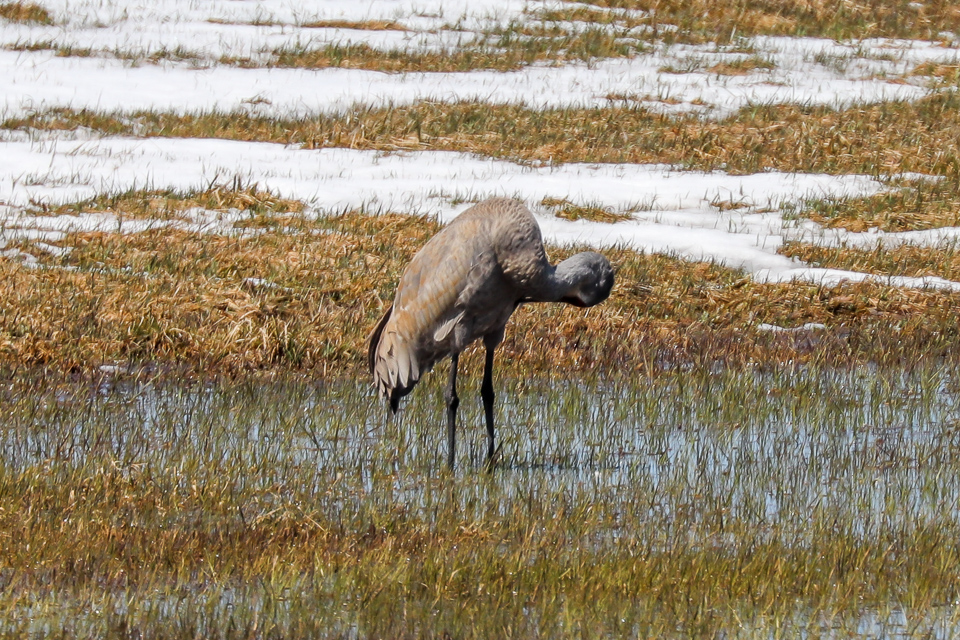
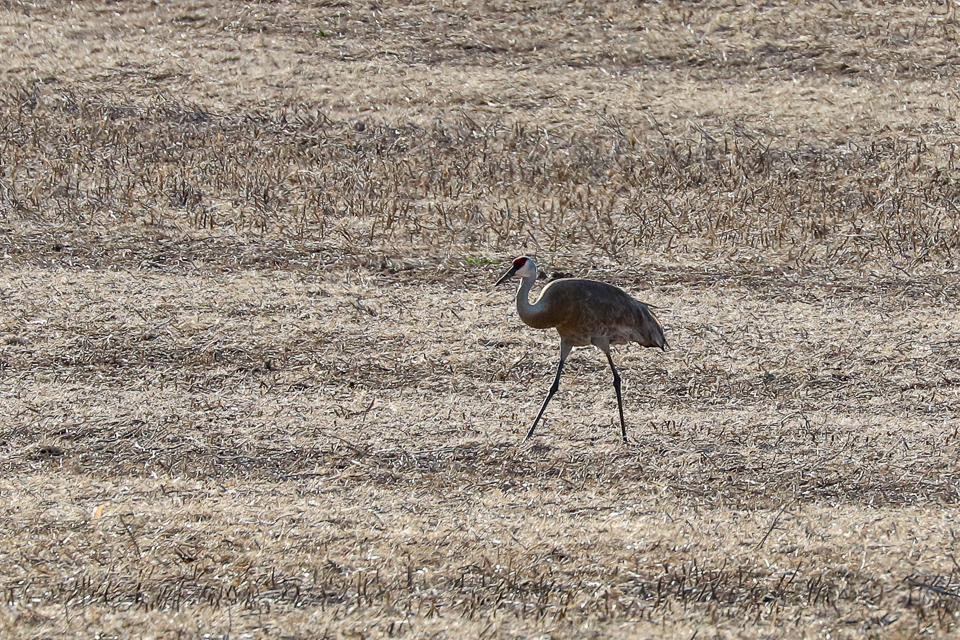
With the season shifting from winter to spring, my focus has moved from Snowy Owls to Sandhill Cranes.  These beautiful creatures make for an engaging three-season subject.


I saw one on a far hillside walking alone in its herky-jerky fashion.  I immediately thought something was wrong with the picture, but I pushed those concerns out of my mind.


A couple mornings later, after we’d had an unwelcome, surprise snowfall, I saw the crane in the same area where I’d seen the two cranes doing their pair-bonding dance.  Again, the crane was alone.  It really stood out on the snow-laden ground.


Even though I wasn’t very close, the lone crane wasn’t comfortable with my presence, and it immediately took to the air.  I watched as it swooped upward with its long spindly legs straight out behind it.


Cranes are such elegant creatures, and I was in awe of its beauty and majesty.  I was puzzled as it flew to the other side of the road.  A worry was forming in my gut, and I pushed it down and moved on.


As I finished my route and came over a hill, I spotted the lone crane at a farmland pond not far from where I’d seen it earlier in the morning.  I finally voiced what I’d been tamping down.  Where was its mate?  Since cranes mate for life and I’d never photographed a crane alone before, my concern grew for this crane’s mate.


While the crane worked at preening itself, various scenarios ran through my mind.  Perhaps, the mate had died at the hands of a predator, such as a fox, raccoon, coyote, eagle, or owl.  If that was the case, the lone crane would be looking for a new mate, but typically not until migration time.


I continued to see and photograph the lone crane over the next few days.  I was hopeful that the bird hadn’t lost its mate to prey, but, instead, was gathering food while its mate tended their nest, typically holding one to three, pale brownish eggs.


I’ve tried to stay hopeful about the absent mate, especially since the lone crane remained in the same area as I’d seen it with its mate.  If luck holds, I might see a hatchling sometime within the next month.  I also held onto the real notion that nature isn't always elegance and beauty.


Thursday, April 18, 2019

WORKING A HABITAT


When I first moved to Traverse City from Northport, I joined the local Audubon club so I could learn where the birding habitats were.


On my first outing with them, we went to a four corners in Mayfield Township, between Traverse City and Kingsley.  On one of the corners was a large marsh.  On the three other corners, there were small wetland ponds like this one.  On that particular day, the ponds and marsh were teeming with migrating birds and waterfowl. 


Since that Saturday morning, this four corners has become my jumping off point for exploring and learning about this area.  It consists of rolling hills, working farms, and abundant roadside wetlands and ponds.


There are many beautiful barns in the area, like this red one in the middle of a corn field.  Its unique roof and stonework base have drawn me to take pictures of it in all seasons.


There are also a fair share of collapsed barns, abandoned silos, and dilapidated buildings, including this interesting structure, perhaps a schoolhouse at one time.


The area I explore three or four times a week is also home to a lot of hunters, as evidenced by the number of blinds set on hillsides and nearby woods.


But it isn’t just the beautiful landscapes and varied architectures that draw me to the area.  It’s the wildlife, birds, and waterfowl I’ve learned will be there when I drive “my route.”  For example, I know I will usually see a herd of deer in certain fields at dusk.  I know I will generally hear Red-Winged Black Birds chirping and trilling when I pass wetland areas.  I know that I often will see two or three bald eagles perched in a distant wood waiting for potential prey to materialize.  Those are the givens when I work this habitat.


And then there are the times when I get lucky.  I’d noticed that a deer had been hit by a car and dragged to the side of the road.  The eagle had seen it too and, on this particular evening, I got to watch as the eagle fed on the roadkill.


I watched as the bird used its giant wings as leverage as it attempted to pull bits of meat from the small end of the deer carcass.


The eagle was very aware of my presence as it looked my way every now and then.  Satisfied that I wasn’t much of a threat, it went back to the business of eating.


But this time, the eagle hovered over the deer while it lowered itself onto the carcass, talons extended.  I couldn’t imagine what it would do next!


Firmly latched on, the bird pulled and tugged until it separated another section that it could more easily manage and consume.


As the eagle continued to use his wings, talons, and beak to tear apart the deer carcass, I decided it was time to move on.  But what a scene I’d been privy to!


As the seasonal roads become more drivable, I’ll be able to work new areas within this main habitat.  I’m also beginning to explore a few areas on the east side of the county where I now live.  Regardless, exploring is one thing I enjoy doing.


Thursday, April 11, 2019

DANCING SANDHILL CRANES RETURN


I’d heard them fly over with their distinctive bugling call.  I’d also seen a few from afar as I combed the countryside for photo ops.


But I’d not seen any Sandhill Cranes up close until a pair flew inside this fenced farmyard.  These large wading birds mate for life and it's always fun to watch the interactions between them.  I noticed their feathers were heavily stained reddish-brown caused by their preening with mud from iron-rich environments.


After reaching their breeding grounds, Sandhill Cranes typically begin their mating process.  One part of this pair-bonding occurs when the birds perform dancing displays.  I’d hoped that would happen with this pair and I didn’t have to wait long for it to begin.  The male crane threw his huge wings into the air as the female largely ignored him.


While the dancing is most common during the breeding season, cranes actually dance all year long.  Here the male twists, jumps into the air, and continues to flap his wings.


Levitating at least a foot off the ground, the crane vocalizes as he dances.  I can only watch in amazement!


The male finally lands, his back feathers still ruffled, while the female continues to show no response.  I wonder what that means?  I’ve seen other pair bonds both involved in the dancing and vocalizing their duet call, so I’m unsure why she’s unresponsive.  Perhaps, she’s not ready yet to mate, in the sense of being fertile.


The male ended his elaborate dance by passing his mate and bowing majestically.  I was in awe at the display but was left with questions that sent me digging for answers.  I found them at Christy Yuncker’s online Photo Journal.  She stated that “males are generally more dashing and females more reserved.”  She further defined the dance steps of Sandhill Cranes.  She said, “When a crane dances solo, the behavior reflects its emotional arousal.  When crane pairs dance, they announce and reciprocate emotions.”


As the pair faced each other, I found meaning in another point Yuncker made in her journal.  “The courtship dances of mated pairs promote hormonal changes that hasten reproductive maturation.”  So my take that the female wasn’t ready to mate yet doesn’t seem so far off.  I hope to follow this beautiful pair as they move to the next stage of courtship.